Baraka StepsGet the book

A Baraka Steps e-book

You know how to pray.
Explaining it is the harder part.

One bedtime story you read aloud, and by the last page, you’ll have the words for every question she’s been asking.

How Does Mummy Teach Her Kids to Pray? · A story of Maghrib, on an ordinary Tuesday.

S$19.99

39 pages · Instant download · Read on any device

Book cover. How Does Mummy Teach Her Kids to Pray? A story of Maghrib, on an ordinary Tuesday. A Baraka Steps book.
  • Instant PDF
  • Any device
  • Ages 3–8

Sourced from Sahih al-Bukhari, Sahih Muslim, Sunan Abi Dawud, Sunan al-Tirmidhi & Sunan Ibn Majah, cross-checked for accuracy.

Four quick questions

Be honest with yourself.

Can your child do the movements?

Most can by six or seven. Hands here, bow here, down here. They pick it up fast, children copy better than they listen.

Has she ever stopped halfway and asked you why?

They all do. Usually at the least convenient moment.

And did you answer with “because Allah asked us to”?

Most of us have. It’s true. It’s also the answer that closes a conversation instead of opening one.

Do you know the fuller answer yourself?

Yes. Somewhere in you, you do.

Now the fifth one.

Could you say it out loud tonight, in words a six-year-old would still be holding on to next year?

That is where most of us stop.

This is not a gap in your faith. It’s a gap in the words.

Nobody ever handed you a way to explain this to a child. You learned salah the way you are now teaching it: by watching someone, and copying. That works for the actions. It has never worked for the meaning.

The movements took a week to teach. The meaning has been waiting a year.

From page 2

“If a child grows up believing salah is a reward for being good, they will stop praying on the first day they stop feeling good. Let them learn early what many of us learned late: salah is not the place we go because we are perfect. It is the place we go because we are not.”

What you walk away with

Her question, and your answer.

Every one of these is already in the book, word for word, with the page it sits on.

“Why do we wash first?”

“Clean hands, clean face, clean heart, as much as we can manage, anyway.”

“Washing is just the beginning, dear. It’s not magic. It’s just
 making space.”

page 7

“Why do we raise our hands?”

“Right now, in this second, you are closing a door. Behind that door is school, is Sarah, is your brother’s toys all over the floor, is everything that happened today, even the burnt rice. In front of you is just Allah.”

page 10

“Why does everyone do it the same way?”

“Tired mothers, happy mothers, sad mothers, all standing the exact same way you’re standing right now.”

“So I’m not alone.”

“You are never, ever alone in this moment.”

page 11

“What does that Arabic even mean?”

“Rabb means the One who nurtures you, who raises you gently, the way a gardener tends a seedling every single day until it becomes a tree. It’s not a distant word. It’s a caring word.”

page 12

“Why do we put our head on the floor?”

“Being still, and low, and quiet tells your whole body: you are safe now. You don’t need to be afraid. You can rest.”

“Is that why I feel sleepy sometimes in sujud?”

“Sometimes, yes. It means your body trusts this moment.”

page 19

You read it once at bedtime. You keep the words for good.

See inside

Three real pages, before you decide

Not mock-ups, these are pages 6, 18 and 35, exactly as they arrive.

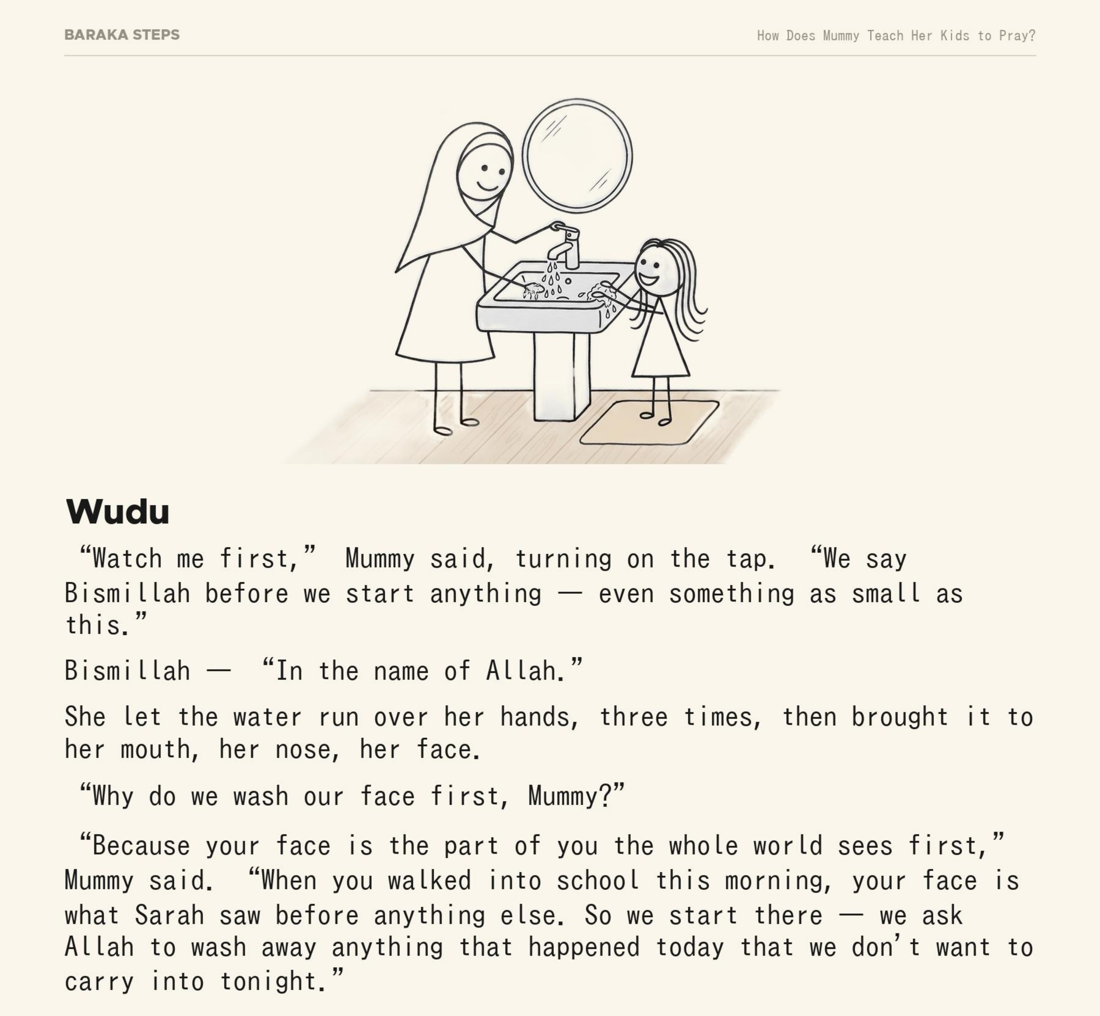
Page 6 of the book. Mummy and Aisha at the sink making wudu, with Aisha asking why we wash our face first.Tap to read full size
Page 6 Aisha asks why we wash our face first. The answer arrives inside the moment, not in a box at the side of the page.
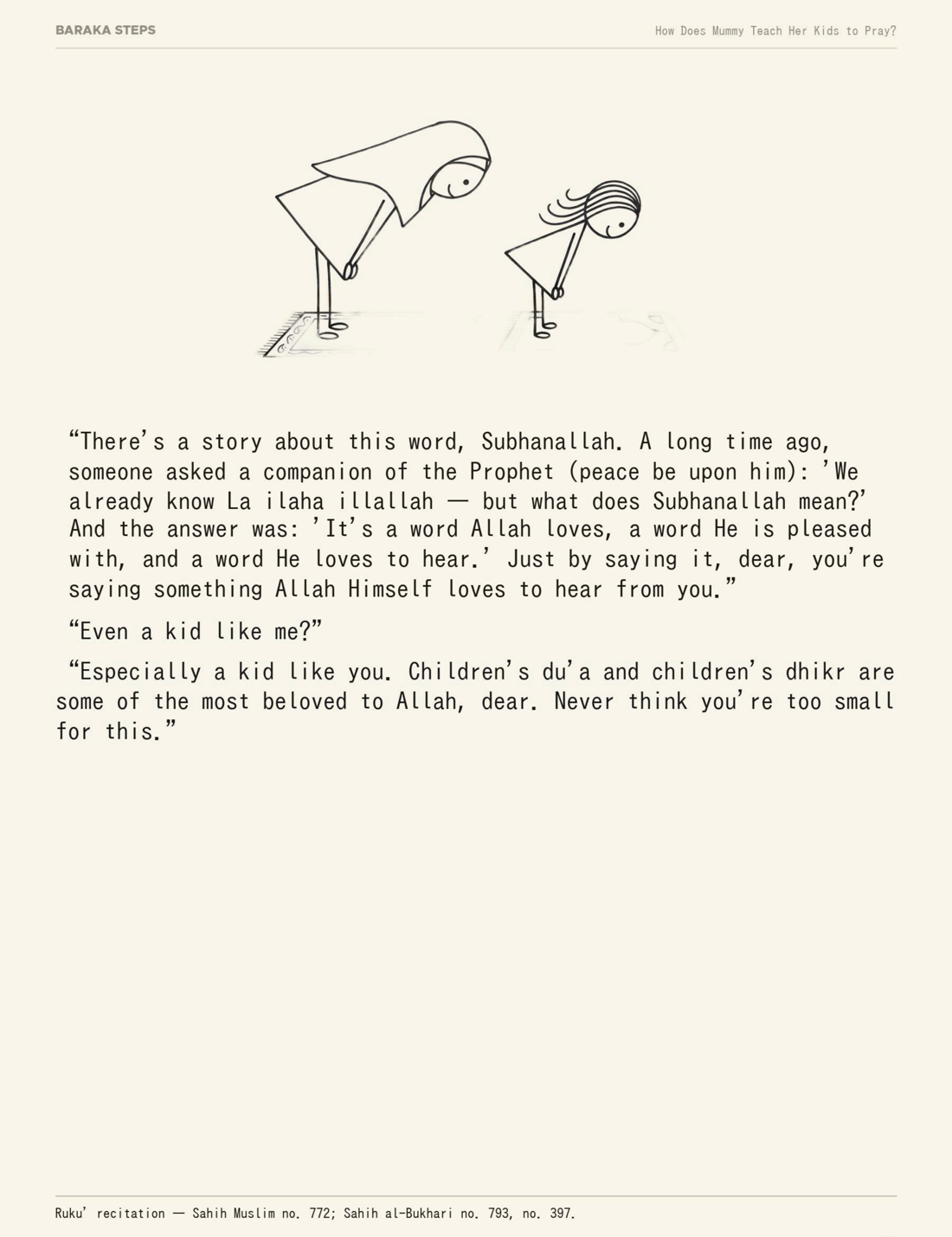
Page 18 of the book. Mummy and Aisha in ruku', with the hadith reference printed at the foot of the page.Tap to read full size
Page 18 “Even a kid like me?”. “Especially a kid like you.” The hadith reference is printed at the foot of the page.
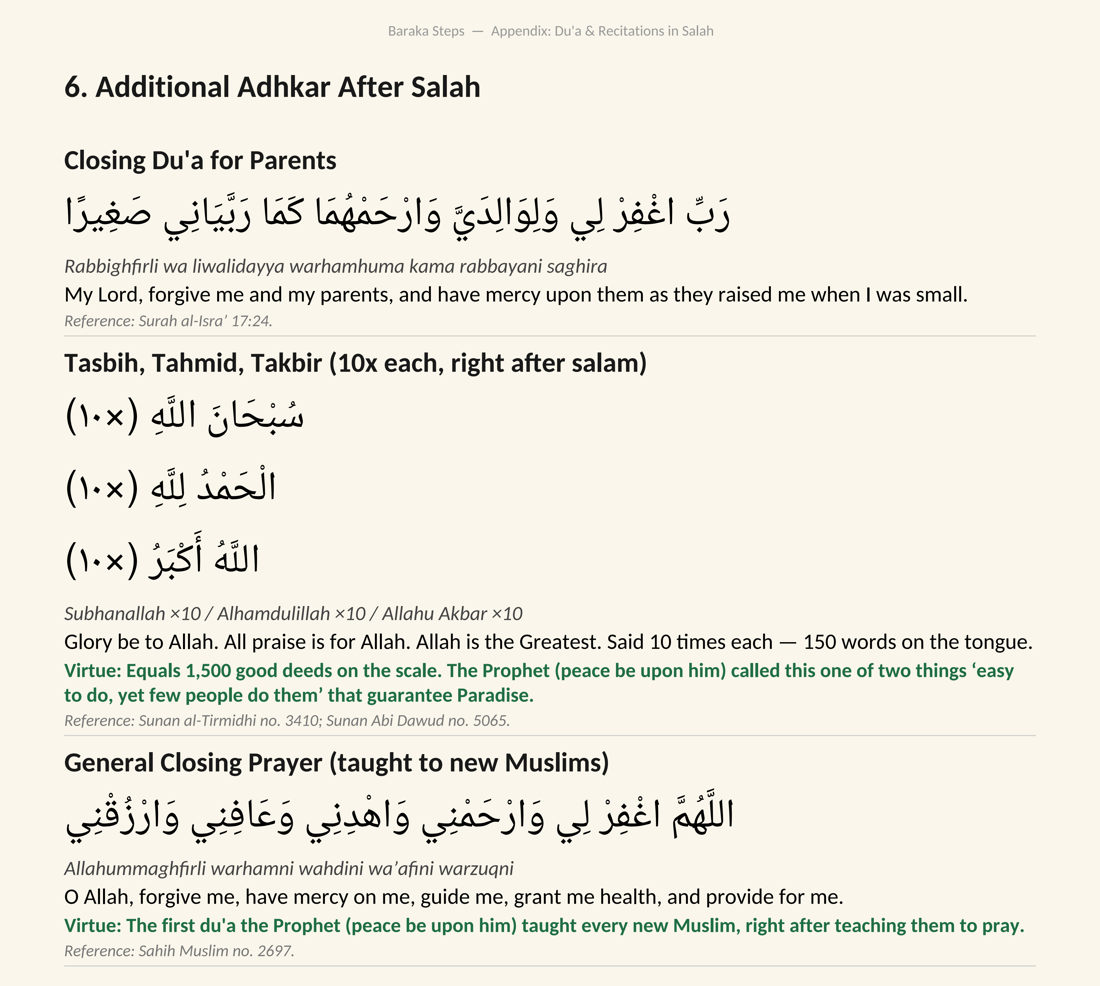
Page 35 of the book, the appendix, showing du'a in Arabic with transliteration, meaning, virtue and source reference.Tap to read full size
Page 35 The appendix: Arabic, transliteration, meaning, virtue, and the collection and number, so you can check it yourself.

What it actually is

Not a workbook. One real story.

Most books teach the motions and leave the meaning for years later. This one runs the other way round.

Aisha has had a hard day, a small falling-out with her friend Sarah. Mummy doesn’t lecture. She prays Maghrib with her, step by step, in real dialogue, so the meaning and the movement always arrive in the same breath:

Wuduyou don’t have to carry today into tomorrow
Standingtired mothers, happy mothers, sad mothers, all standing the exact same way
Sujood“the safest kind of small there is”

And Mummy is not a perfect mother. She burnt the rice and lost her patience today, and she says so out loud, in the middle of teaching her daughter to pray.

“Salah isn’t a reward for being good. It’s a place to go because we’re not perfect.”

At the back · worth keeping

A full reference appendix

Every recitation in the prayer. Arabic, transliteration, meaning, virtue, and its Qur’an/hadith source, cross-checked against the major hadith collections. For when you want to go deeper.

Who wrote this

Amar Hamzah Abdur Rahman

Almost every book written for Muslim parents answers two questions: how and what. Stand here. Say this. Bow now. Those were never the parts I was worried about, a child can learn those in a week.

A remarkable child is raised by a mother who understands her faith, not only one who performs it. So she has to be given the why shown the meaning behind each movement, so that when her child finally asks, she is not reaching for an answer.

“A great child comes from a great mother. So teach the mother first.”

Simple pricing

One book. One honest price.

How Does Mummy Teach Her Kids to Pray?

S$19.99
  • The full illustrated story. 39 pages in all
  • Every salah step taught through the story
  • Complete du‘a & reference appendix, each source cited by number
  • Read on phone, tablet or computer
  • Yours to keep, lifetime access

Secure checkout by Stripe · Card, Apple Pay, Google Pay & Link

Refund policy

On the price

The story takes one bedtime. The words last a lot longer.

You read it once with your eldest. Then you have it for the second child, and the third, the same words, already in your mouth, no second purchase.

And the appendix doesn’t expire. It’s still there in five years, on the night she asks what Rabb actually means, or wants the source for a du‘a she’s been saying since she was six.

S$19.99, once. Not a subscription. Not a course you won’t finish. Not an app that stops working. A file on your phone that belongs to you.

A bubble tea run for the familygone by tonight
One takeaway dinnergone by tonight
Thisthe words for a conversation you’ll be having for years

One payment of S$19.99, for something you will still be using when she is old enough to read it herself.

And if you never opened it again after tonight?

You would still have the five answers further up this page. Those are already yours, you read them a minute ago, and nobody can take them back. The other thirty-four pages are simply the rest of the prayer.

Faithful, and honest about it

Grounded, and cross-checked

The prayer follows the Shafi‘i madhab throughout. Every du‘a and hadith is sourced from the major collections. Sahih al-Bukhari, Sahih Muslim, Sunan Abi Dawud, Sunan al-Tirmidhi and Sunan Ibn Majah, and cross-checked for accuracy. The appendix shows you each reference by number, so nothing is taken on trust.

Sources: Sahih al-Bukhari · Sahih Muslim · Sunan Abi Dawud · Sunan al-Tirmidhi · Sunan Ibn Majah. Cross-checked for accuracy.

Questions

Before you buy

What device can I read it on?

It’s a PDF, so it opens on any phone, tablet, laptop or e-reader, no app needed. Your download link is emailed the moment you pay.

Is it accurate? Which madhab?

It follows the Shafi‘i madhab throughout, and says so plainly, where a wording has equally authentic variations across schools, the appendix notes it. Every du‘a and hadith is sourced from Sahih al-Bukhari, Sahih Muslim, Sunan Abi Dawud, Sunan al-Tirmidhi and Sunan Ibn Majah, each cited by number, so you can check every source yourself.

What age is it for?

The story suits roughly ages 3–8, and the depth in the dialogue and appendix means it grows with your child, and teaches you, too.

Does it explain why we have to pray at all?

It gives your child a reason to want to, closing a door on the day, never being alone in that moment, a place to go precisely because we’re not perfect. It’s a story, not a fiqh manual: it won’t argue the obligation, it will make the obligation make sense.

Can I get a refund?

Because it’s an instant digital download, all sales are final and we’re unable to offer refunds once the book is delivered. But if something’s wrong, the file won’t open, or you were charged twice, email us and we’ll always make it right.

What about my privacy & payment?

We only use your email to send your download and receipt. Payments are handled securely by Stripe, we never see or store your card details. Full details in our Privacy Policy.

Tonight, when she asks

She will ask again, why we wash first, why we bow, why we have to at all. You already know the answer. This just gives you the words for it.

S$19.99